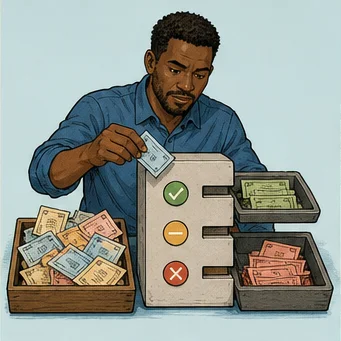

Time-based restrictions represent a silent killer for many evaluation accounts. You might possess a brilliant market view and an entry trigger that fires perfectly, but if the trade crosses a prohibited window, your success becomes irrelevant. A position held through a significant data release, a market close, or an entire weekend often faces sharp execution risk alongside potential rule violations. These firm-specific policies apply regardless of whether the trade actually generated profit or incurred a loss during the restricted period.
Making the firm's current wording your primary authority is essential. Restrictions frequently differ by financial instrument, the stage of your account, the specific event type, and the local time zone the firm dictates. You must understand if the policy restricts opening, closing, holding, or simply generating profit during these windows. Failing to distinguish between these nuances leads to avoidable account disqualification. This guide outlines how to integrate these constraints into your daily workflow to keep your capital safe.
Readers building a complete challenge plan can pair this review of prop firm news trading and weekend rules: plan around restricted windows with the prop firm passing service guide, which compares the wider support process and its limits.
Why Restricted Windows Matter
Scheduled economic releases and market closes fundamentally alter the mechanics of price movement. Spreads often widen significantly, liquidity evaporates, and price gaps occur within mere milliseconds of a headline. Rules against trading during these times exist because a normal stop loss order may fail to execute at your requested price. In these volatile conditions, you face slippage risks that exceed the normal tolerances of your strategy.
Think of the restricted window as a core filter for your trade setups rather than an afterthought. Even if a chart looks perfect and your indicators align, a trade is inherently ineligible if its projected holding period traverses a prohibited time. You must weigh the potential reward against the binary risk of a firm rule violation. A trade that cannot survive a brief holding period without crossing a restricted zone is often not worth the administrative stress.
Consider a scenario where you spot a breakout signal for a currency pair five minutes before a major central bank announcement. The technical setup might suggest a strong momentum move. However, the firm prohibits holding positions through the high-volatility window. Opening this trade forces a choice between closing at an arbitrary time or violating a rule. The best approach is to identify these zones before you ever look at a chart, effectively removing the temptation to override your risk management.
Interpret the Firm's Wording
Language matters when reading firm guidelines. Does the rule specifically prohibit opening a new position, or does it also forbid holding existing exposure? Some firms only care about profit earned during the window, while others mandate a complete absence of risk. You must also identify exactly which instruments, account stages, and time zones apply to your specific situation. A rule for a futures account might not apply to a forex account, so avoid making assumptions based on general industry knowledge.
Never infer permission from silence. If a policy manual does not explicitly state that holding a position is okay, assume it is forbidden. Using another program's policy as a reference is dangerous because firms constantly update their terms to manage their own risk profiles. When in doubt, seek written clarification from the support team about positions opened before an event that you intend to hold through the release. Keep that confirmation saved for your personal records in case a dispute ever arises.
Understand firm news rules
Hypothetically, suppose a firm rule says you cannot trade during high-impact news. This is vague. Does that mean the minute of the release or the 30 minutes surrounding it? If the firm defines the window as two minutes before and two minutes after the release, adhere to that strictly. Do not try to shave time off the ends. Being five seconds early into a restricted window is just as much a rule violation as being five minutes early.
Build a News Calendar
Building a reliable calendar starts before the week begins. Use a consistent source for economic data and update your view every day before the market session starts. Include central bank decisions, inflation reports, employment data, and instrument-specific events that matter to your target markets. If you trade indices, pay extra attention to interest rate announcements. If you trade commodities, focus on supply-side reports and geopolitical updates that can trigger sudden spikes in volatility.
Assign a definitive action to every event you flag. For each high-impact release, you must decide in advance whether you will avoid new entries, reduce your position size, close your entire exposure, or trade only if the strategy allows for rapid adjustments. Documenting this decision in your trading journal creates a mental commitment. When the pressure hits during a live market, you will not have to think about what to do, as your plan will already dictate the logical response.
Follow a news calendar
For an illustrative example, imagine a trader who tracks the monthly non-farm payroll report. They decide their policy is to close all open positions 60 minutes before the release. They also plan to wait until 15 minutes after the release to re-enter. By writing this in their journal, they remove the impulse to check the market during the transition period. This disciplined approach keeps the focus on process compliance rather than trying to guess the direction of the market move.

Overnight and Weekend Planning
Holding positions overnight or through the weekend introduces unique risks. Even if the firm technically allows it, you face gap risk at the open, swap charges, and potentially low liquidity in the overnight session. Check the exact market close time and the conditions for reopening. You also need to confirm whether your pending stop loss or take profit orders will remain active or if they might trigger in an illiquid market, leading to a disastrous fill price.
Always decide before you enter a trade whether your thesis can be closed safely inside the allowed window. If your technical setup requires a long-term swing that persists over the weekend, ensure your account rules permit this. Do not allow yourself to convert an intraday loss into a weekend hold just because you feel uncomfortable with the current loss. This behavior often leads to wider losses when the market reopens with a significant price gap against your position.
Plan for weekend gaps
Think of a hypothetical case where a market closes on Friday at 5 PM. A trader holds a position that is currently showing a small loss. Instead of closing the position and accepting the loss, they decide to hold it until Monday morning. When the market opens on Monday, a geopolitical event over the weekend causes a price gap that is 10 times larger than the Friday loss. By refusing to follow a rule-based plan, the trader turned a small annoyance into an account-ending event.
Event-Driven Strategies
Strategies designed around economic releases require specific modeling. You must account for worse-than-normal fills and the very real possibility that you cannot adjust your orders once the market begins to move. Backtests that rely on clean candle closes often fail to account for this execution risk. In a real environment, the price you see on your screen might not be available for your trade, and your order might be rejected due to latency or extreme volatility.
Confirm that the firm specifically permits your chosen approach. This includes strategies like straddles, rapid order cancellation, or holding through the release. If your strategy relies on being able to react instantly to a price shift, but the firm restricts high-frequency order changes during news, you will find yourself stuck. If the rules do not support your preferred method, choose a different time session or adjust your strategy to avoid these high-risk periods entirely.
Consider a hypothetical trader who uses a strategy to straddle a major inflation release. They set buy and sell orders on both sides of the current price. During the actual event, the market moves so fast that only the buy order gets triggered, and the sell order fails to cancel. The trader is now over-leveraged and trapped in a bad position because they did not account for the firm's specific execution limitations about order management during the news release.
What Passing Support Can Monitor
Support teams can provide value by flagging calendar events, calculating your remaining exposure, or reminding you of a specific cutoff. However, you must never treat these warnings as a fail-safe. Support cannot replace your personal responsibility for checking the current firm wording or managing your open orders. If a warning fails to arrive because of a technical glitch, the responsibility for the resulting rule violation still rests entirely on your shoulders.
Set clear expectations for who monitors what and how a warning reaches you. A reminder delivered after the restricted window has already begun is useless. You must have your own system in place that works even if the platform notifications fail. Use a secondary calendar, set physical alarms, or keep a checklist on your desk. The goal is to ensure you are never blindsided by an event, regardless of what information the platform provides.
Imagine a hypothetical scenario where a firm's system is supposed to alert you 10 minutes before a news event. You rely on this alert to close your position. During the event, the server experiences high traffic and the alert is delayed by 15 minutes. By the time you get the message, the restricted window has already begun. Because you relied solely on the firm's tool, you now face a penalty. Always maintain an independent monitoring system to prevent such dependencies.

Related guide for Prop Firm News Trading and Weekend Rules: Plan Around Restricted Windows: A useful companion for this decision is How to Check Prop Firm Rules Before You Start a Challenge. Many failed evaluations begin with a rule the trader did not know existed. Save this checklist and review the firm's own terms before you place the first trade.
Handling Unexpected Events
Unscheduled news headlines do not create an obligation to act. When volatility spikes without warning, your first priority is to assess your exposure and the status of your stops. Check if the market remains tradeable under your current plan. Sometimes, the best action is to sit on your hands and wait for the dust to settle, especially if your initial position is already protected by a well-defined stop loss order.
Avoid the temptation to widen your stop or add to your position size simply because the market is moving quickly. If you are already in a trade and the market turns against you, adding more size only increases your potential for a larger drawdown. If the execution conditions appear abnormal, closing your position and moving to the sidelines may be more controllable than trying to manage a trade in a market that has effectively stopped behaving normally.
Consider an illustrative example where a sudden political announcement causes a major index to drop sharply. An inexperienced trader might see the drop as a chance to buy at a discount and add to their position. However, the price is not following technical levels and is driven by panic. The trader gets stopped out at a much worse price than planned. A more experienced approach would be to wait for the volatility to subside before attempting any new moves.
Restricted-Window Checklist
Before you enter a restricted window, you must perform a final check. Confirm the firm time, the scope of the event, all current orders, any open positions, and any pending orders that might trigger. Do this early enough that you can close or adjust your exposure without rushing. Being in a hurry is the fastest way to make a mistake, like closing the wrong position or failing to cancel a pending order.
After the window passes, verify your account status before treating the session as normal. Ensure all fills are accurate and that you have not inadvertently violated any rules. Keeping a copy of your pre-session checklist in your trading journal provides evidence of the process you used. This also helps you see patterns in your own performance and refine your planning for future events.
Use a simple list to guide your pre-trade sanity check. First, identify the exact time the restriction starts. Second, scan for any pending limit or stop orders on the active instruments. Third, verify that your current position size is compliant with all holding rules. Finally, ensure you have a plan to exit the trade if the volatility exceeds your expectations. Checking these four items consistently will prevent the most common types of accidental account breaches.
Developing Mental Discipline
Trading requires immense focus, especially when external rules limit your options. You must learn to separate your personal desire to trade from the constraints imposed by the program. It is natural to feel frustrated when a good setup is disqualified by a time restriction, but this is a necessary part of the game. Developing the discipline to walk away when a trade is ineligible is a sign of a professional mindset.
Reframing the way you view restrictions can help. Instead of seeing these rules as barriers to your profits, look at them as essential guardrails that keep you from blowing up your account. By avoiding the most chaotic periods of the market, you actually protect your capital for the times when you have a higher statistical edge. This shift in perspective transforms a limiting factor into a core part of your risk management strategy.
Consider the mental fatigue that comes with tracking news events. It is demanding to maintain this level of attention throughout the entire day. For this reason, many successful traders choose to focus on only one or two segments of the trading session. By narrowing your focus, you make it much easier to stay on top of the news and to remember the rules that apply to your specific instruments. Simplicity often beats complexity in the long run.
Managing Data and Information
Information overload is a real problem for modern traders. You are constantly bombarded with news feeds, social media alerts, and platform notifications. To survive, you must curate your information sources. Choose one or two high-quality economic calendars and ignore the noise from the rest. When you have too many sources, you end up with conflicting information about what constitutes a high-impact event, which creates unnecessary confusion.
Keep your data organized in a way that makes sense to you. Some traders prefer a digital calendar, while others like to write things down on a physical board near their desk. The method matters less than the consistency. Whatever tool you use, make sure it is updated at least once a day. If you find yourself having to search for information in the middle of a trade, you are already behind the curve.
Think of a hypothetical setup where a trader uses a high-end data service but refuses to cross-reference it with the firm's provided calendar. One day, the data service marks a release as medium impact, but the firm considers it high impact. The trader continues to trade, only to find their account disabled later. By using the firm's official event list as your single source of truth, you avoid these discrepancies entirely.
Evaluating Your Process
After every trading week, review how well you handled the restricted windows. Look back at your journal entries and see if you missed any events or if you felt rushed during the cutoff times. If you notice a trend of being unprepared, adjust your pre-session routine. Perhaps you need to start your research earlier in the morning or add more detail to your event calendar. Constant refinement of your process is what leads to long-term consistency.
Be honest with yourself about your failure cases. If you broke a rule, identify exactly why it happened. Did you misread the time? Did you forget about the event entirely? Did you think you could sneak in one last trade before the cutoff? Identifying the root cause is the only way to ensure it does not happen again. Keep a log of these mistakes and review them every Monday morning before you start trading.
Consider a hypothetical trader who realizes they missed three news events in one month because they were focused on a different chart. They decide to create a new rule: no trading any instrument until they have manually checked the daily news calendar and highlighted the restricted windows on their main screen. By making this small process change, they completely eliminate the risk of missing a major event in the future. Small adjustments make a massive difference over time.
Maintaining Consistency
Consistency is not just about your trading style, it is about your entire process. When you treat the preparation phase as seriously as the execution phase, you naturally reduce your error rate. Consistency also means applying the same set of rules to every trade, every day. When you make exceptions for one trade but not another, you introduce bias into your decision making, which leads to erratic results.
Develop a standard operating procedure for your trading day. Start with your calendar check, then move to order management, and finally, execute your trades according to your plan. By repeating this cycle, you will eventually reach a point where following the rules becomes second nature. This allows you to spend more of your mental energy on actual market analysis, which is where you derive your edge.
Think of it like an athlete who follows a strict pre-game routine before every match. They do the same stretches, the same warm-ups, and the same mental preparation every time. They do not get bored of it because they know it works. You should approach your trading in the same way. By making your preparation a ritual, you take the stress out of the process and put the focus back on the execution of your plan.
Related guide for Prop Firm News Trading and Weekend Rules: Plan Around Restricted Windows: For the next practical part of your preparation, continue with Prop Firm Challenge Platform and VPS Checklist for Reliable Execution. Technical issues can create slippage, missed exits, or rule breaches. Use this platform and VPS checklist before relying on a challenge account.
Long-Term Survival
The primary goal of any trader is survival. You cannot win if you are out of the game, and rule violations are a quick way to lose your seat at the table. By being diligent about restricted windows, you are doing more than just avoiding penalties. You are building the foundation of a sustainable career. Every trade you protect from unnecessary risk is a win, even if that trade does not result in a direct profit.
It takes time to build the habit of planning around restricted windows. You might stumble at the beginning, and that is okay, provided you learn from it. Each time you face a challenge and manage it correctly, your confidence grows. Eventually, you will reach a level of comfort with these rules that allows you to operate smoothly even in the most volatile market environments. Patience and persistence are your best allies.
Consider a hypothetical trader who has survived three years of evaluations without a single rule violation. Their secret is not that they are better at predicting the market than anyone else, but that they are disciplined enough to stay out of the market when the rules say so. They understand that a trade not taken is often the best trade of the day. By focusing on longevity, they have managed to build a consistent and reliable track record.
Algorithmic Risk Assessment
Automated tools often fail to recognize that restricted windows operate on absolute time, not just price movement. You might assume your algorithmic execution logic is safe, but code frequently ignores the context of a news event. If an algorithm sends a buy order milliseconds before an official news cutoff, your account incurs a violation. You must treat every line of your automation as a potential source of rule failure. Audit every entry point for hard-coded time filters before you deploy your code.
Hypothetical scenario 1: You run a scalping bot that enters positions when a 5-minute moving average crosses a 10-minute average. The bot executes 15 trades every session. One morning, the bot enters a trade at 8:29 AM. The firm restricts all trading from 8:30 AM to 8:35 AM for an interest rate report. The bot does not know the news is coming, so it holds the position through the event. You now face a violation because your logic lacked a mandatory calendar-based disable function.
Automate risk assessment tools
Hard-code your calendar events directly into your trading logic. Use a Boolean variable that switches to false during restricted windows. This prevents your platform from sending new requests to the server during prohibited times. Never rely on manually clicking a button to stop your algorithm when the clock hits the restricted mark. Human response time is too slow compared to the speed of your automated scripts.
Consider the latency of your connection to the firm server. If your script checks the clock at 8:29:59 and sends a request, the signal might reach the server at 8:30:00. Even if your internal clock says you are safe, the firm server perceives the violation immediately. Build a buffer of at least 60 seconds into every time-based rule in your script. This safety gap absorbs minor network delays that otherwise trigger automated account flags.
Monitor your account logs daily to ensure your code followed these internal restrictions. Even if no trade occurs, verifying that your script correctly skipped a restricted window builds confidence in your setup. If you find your script attempted to trade, investigate the specific code path that allowed the signal. Continuous testing keeps your automation compliant with the firm standards.
Leveraging Instrument Spreads
Different financial instruments face different restricted windows, even within the same account. You must map these nuances across your entire product list. For instance, a firm might block trading on gold during a CPI announcement but keep indices open for institutional traders. If you diversify your portfolio, you carry the heavy burden of tracking multiple time-based rules simultaneously. Do not assume that a rule for one asset class applies to all others.
Hypothetical scenario 2: A firm limits trading on the EUR/USD pair during a central bank speech. However, the GBP/USD pair remains tradeable because the news only relates to the Eurozone. You might think your strategy is safe because you switch from EUR/USD to GBP/USD during the restricted window. If the rule explicitly bans all trading on major pairs, you lose your account regardless of the specific currency symbol. Always read the policy for each specific ticker you intend to trade.
Leverage instrument spread sensitivity
Grouping your instruments by their sensitivity to news helps simplify your planning. Create categories such as highly volatile, moderately impacted, and stable assets. When a high-impact news event occurs, prioritize closing positions in the highly volatile group first. This structured approach ensures you handle the highest-risk assets before you attend to the slower ones. It turns a chaotic event into a predictable sequence of actions.
Review your instrument list weekly. Firms frequently adjust which assets they restrict based on market conditions or liquidity changes. A pair that traded freely last month might move to a restricted status today because of increased geopolitical sensitivity. Checking your dashboard every Monday saves you from trading a newly restricted instrument and risking an accidental breach of the updated rulebook.
Use a spreadsheet to track the specific windows for every asset you trade. List the instrument, the relevant time zones, and the prohibited event types. When a new report appears on the news feed, scan your spreadsheet to see if any of your open instruments appear on the list. This quick reference prevents you from making emotional guesses during the heat of a market session.
Managing Trailing Stop Gaps
Trailing stop orders pose a significant risk during volatile windows. If a market gaps over your stop price because of a sudden news release, your order executes at the first available price rather than your trigger price. This results in a massive loss that far exceeds your intended risk. You must evaluate whether a trailing stop provides safety or danger during high-impact time periods. In some cases, disabling the trailing feature before the news is the only way to avoid a catastrophe.
Hypothetical scenario 3: You have a long position on a major index with a trailing stop set to follow 50 points behind the current price. An unexpected economic report causes a massive downward gap of 200 points in one minute. Your trailing stop executes at the bottom of the gap. Because the market moved too fast, you lose 200 points instead of your intended 50. If you had disabled the trailing stop and used a static limit order, you might have controlled the exit much more effectively.
Manage trailing stop gaps
Consider moving to fixed stop losses when a news event approaches. Fixed stops provide a clear ceiling on your potential loss that does not drift with the market price. While you might give up some upside potential if the market moves in your favor, you trade that gain for the certainty of a known exit point. Stability is the priority when you are operating near a restricted window.
Test your broker's behavior about order execution during gapping markets. Some platforms execute stops at the market price, while others attempt to fill at your requested level. Understanding how your specific platform handles these gaps is vital. If your platform guarantees fills only during normal conditions, you must assume the risk of a poor execution during a high-volatility event. Factor this into your risk management strategy before the event begins.
Avoid keeping complex order structures like OCO, or one cancels other, during restricted windows. These systems rely on continuous data flow to manage the relationship between your orders. If a news event causes a data lag, the system might fail to cancel the secondary order. You end up with an unintended open position that violates firm rules. Keep your order management simple and manual during these high-risk hours.
Contingency Planning for Tech
Technical failures represent a unique threat to your eligibility. If your internet connection drops or your computer crashes during a restricted window, you have no way to exit a position that is rapidly losing value. You must have a secondary device ready at all times. This could be a mobile phone with the trading app installed or a backup laptop connected to a different internet provider. Being disconnected is not an excuse for breaking a firm rule.
Hypothetical scenario 4: You are 5 minutes away from a mandatory cutoff time for a major news release. Your main computer suddenly experiences a blue screen crash. You try to reboot, but it takes 10 minutes. By the time you log back in, the prohibited window has started, and your position is still open. You have now violated the rule because you were not prepared for a basic hardware failure. A backup device would have allowed you to close the trade in seconds.
Create tech contingency plans
Test your backup connection regularly. Do not assume your phone app works correctly just because you installed it. Open the app and log in at least once a week to ensure your credentials are valid and the connection is stable. Make sure you know exactly how to close a position on your mobile interface. Practicing this on a small demo trade saves you from fumbling with buttons during a real-time crisis.
Maintain a list of critical support contacts for your firm and your internet provider. If the issue is with the firm's platform, you need to reach them immediately to document that you attempted to act. If the issue is with your local internet, having a backup 4G or 5G hotspot ensures you can still access the markets. Control the variables that you can control, even if they seem minor during calm market sessions.
Monitor real-time account status
Always keep your account balance and current positions visible on a second monitor if possible. Seeing your status in real-time allows you to spot an issue before it becomes a rule violation. If you notice a platform freeze or a data stall, take immediate action to close your trades. Waiting for the system to recover is usually a mistake. A small, early exit is always better than a late, forced disqualification.
Final Takeaway
Before each trading session, mark all restricted windows in the exact time zone used by the firm and set an alert well before the cutoff. Decide in advance whether you will close, reduce, or leave your open risk untouched, and only choose actions that the rules expressly permit. If you feel uncertain, always assume the strictest interpretation to prevent an accidental breach.
Unexpected news headlines require a contingency plan rather than a prediction of the future. Know the maximum loss you are willing to accept, avoid the temptation to add size during fast market movements, and document every time you take action in your journal for later review. Maintaining a rigid, repeatable process is the best way to handle market noise, protect your capital, and ensure that you remain in the game over the long term.