
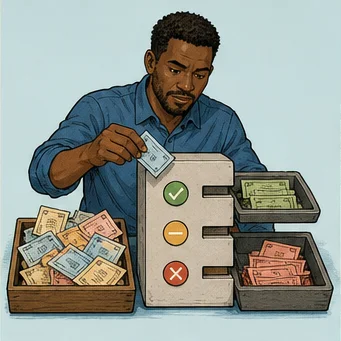
Proprietary trading firm challenges operate under strict governance that many participants neglect until a rule violation occurs. Successfully navigating these programs requires moving beyond the surface level marketing materials to the granular technical requirements located in legal agreements and dashboard interfaces.
A single trade placed during a restricted news event or an account exceeding a trailing drawdown limit can immediately disqualify a participant. This guide focuses on constructing a personal operational rule sheet based directly on the current terms provided by your specific firm. By transforming dense legal text into a clear checklist for your unique account model, you remove the guesswork from your daily routine and minimize the risk of accidental breach.
The process of creating this internal document is the most vital step in preparing for a challenge. You are not just reading policies; you are defining the exact operational boundaries that dictate whether your account remains active. Relying on memory or general industry knowledge is a common failure point that often proves costly in the long run. Follow these steps to ensure you remain fully compliant throughout the life of your program.
If you are comparing independent preparation with structured support, the main prop firm passing service guide places how to check prop firm rules before you start a challenge inside the complete evaluation process.
Start With the Current Rule Source
Your account rules are dynamic and specific to the exact program you purchased. Relying on third party reviews or outdated forum posts is a dangerous habit because firms frequently adjust their terms. You must navigate to the specific legal agreement, dashboard FAQ, and any direct support correspondence that pertains to your active program. These are the only documents that define your actual limitations.
When you locate the relevant documents, save them locally rather than relying on browser bookmarks that might break or redirect to updated pages. If you find a policy that feels vague or potentially contradictory, send a request to support for clarification. Record the name of the representative and the date of the message. If the support reply contradicts the agreement, use the written clarification as your primary rule until the firm updates the official documentation.
Consider this a living administrative task. Date your notes clearly so you can differentiate between outdated internal protocols and current ones. Many firms update their instruments list or economic calendar policies without broad announcements. Regular audits of your source documents ensure that your internal rule sheet reflects the firm's most recent requirements. If you trade on an outdated interpretation, the firm will rarely accept a mistake as a valid defense.
Daily Loss and Maximum Drawdown
The drawdown limit is the most critical constraint in any prop firm challenge. You must distinguish between a static threshold and a trailing drawdown, as these function differently during a profitable streak. A static threshold remains constant until the account equity crosses a predefined level. A trailing drawdown, however, moves upward as your account balance increases, often locking in your highest point of success and creating a tighter margin for error.
Model the math behind your specific drawdown calculation before placing your first trade. Ask yourself if the limit is based on closed equity or floating equity, as this distinction determines how the system views your open positions during a volatile market. If your maximum loss limit is $5,000, a floating loss of $4,500 during a temporary pullback might feel safe to you, but the firm may trigger a breach if they track open trades.
Always keep a clear buffer between your actual balance and the limit. If you have a maximum drawdown of $1,000, treat your effective limit as $750. This creates a defensive cushion for spread fluctuations or sudden market gaps. Never assume that the firm will allow you to reach the absolute penny of your loss limit. A small slip in execution or a wide spread during a news event could hit your limit instantly, ending your challenge regardless of your intent.
News, Overnight, and Weekend Restrictions
Prop firms often enforce strict policies on when you can trade relative to major economic releases. Some firms require that all positions be closed 2 minutes before a high impact news event and forbid new entries until 2 minutes after. You must know if this applies to every instrument you trade or only to specific currency pairs or indices. A breach in this area is usually automated and results in immediate disqualification.
Overnight and weekend holdings are another common trap for the unprepared trader. If your program restricts trading over the weekend, you must ensure that all positions are closed according to the firm's server time, not your local time. Daylight saving time changes can shift these windows unexpectedly, so always check the firm's current server time. If you miscalculate the closing window by even 30 seconds, your account may be flagged as a violation.
If your strategy requires holding positions, read the specific documentation about what constitutes a hold. Some firms allow you to hold trades over the weekend if you receive special permission, while others strictly forbid it for all account types. Never assume that a rule for one account type applies to your specific program. If the firm uses a specific news calendar to define restricted events, bookmark that page and check it every morning before your platform opens.

Strategy and Execution Restrictions
Automation and copy trading require careful handling. Even if a firm allows Expert Advisors, they may prohibit specific types of execution, such as high frequency trading or arbitrage strategies. You must verify if your automated tool creates order volume that the firm considers abusive. An expert advisor that is perfectly compliant in one environment might behave differently under the specific latency or execution rules of your prop firm.
Test every automated tool in a simulated environment offered by the firm if available. Run the tool exactly as you intend to trade it live. Look for unintended duplicate orders or unusual sizing patterns. If you use multiple accounts, confirm that the firm allows the same strategy to run on all of them simultaneously. Some firms have strict rules about common control, where they treat multiple accounts as one to prevent you from using different strategies to bypass risk limits.
Consider a hypothetical case where you use an automated trailing stop. If that script sends constant tiny modifications to the server, the firm might flag it as spamming or high frequency activity. You should always reach out to the firm's technical support to confirm that your specific tool's behavior is acceptable. Documenting this conversation protects you if the firm's risk management system flags your account later for activity they previously approved.
Consistency and Position Sizing Rules
Consistency rules are designed to prevent traders from passing challenges with a single lucky trade. A common rule requires that no single day of profit accounts for more than a certain percentage of your total challenge gain. If you have a target of $10,000 and the rule says one day cannot account for more than 20%, you cannot make $3,000 in a single session, even if it is legitimate market movement.
Calculate your standard risk unit and stick to it. If you decide that 1 lot is your standard, avoid jumping to 5 lots just because you see a setup you really like. This deviation can flag your account for inconsistent behavior. When you review your stats before a payout, the firm will look at your trade sizes. If your size varies wildly, you might be denied a payout because the system views your success as unsustainable or risky.
This is not about being profitable; it is about demonstrating a controlled process. You can be highly profitable and still fail the consistency check if your profit distribution is too skewed. Monitor your trade logs throughout the month. If you find yourself approaching the limit of what is allowed for a single day, stop trading for that session. It is far better to miss a few hours of opportunity than to jeopardize the entire account status.

Related guide for How to Check Prop Firm Rules Before You Start a Challenge: A useful companion for this decision is Understanding Prop Firm Challenge Risk Rules Without the Jargon. Risk rules decide whether an evaluation survives normal variance. This guide translates the most important terms into daily trading decisions.
Verification and Payout Conditions
Reaching the profit target is not the final step. Most firms require a verification period where they check your trading history for rule compliance. During this time, your ability to trade may be suspended. Do not make any financial plans or commitments based on a payout until the firm has officially approved your request and the funds have been sent. The waiting period varies significantly between different programs and firms.
Check the specific requirements for your payout. This often includes providing identification documents, signing a new contract, and meeting a minimum number of trading days. If you reach your profit target in 2 days but the firm requires a minimum of 10 active trading days, you must continue trading for the remaining 8 days. Ensure your trading during this period remains as disciplined as it was during the challenge phase.
Understand how the firm handles your profit split. If you are entitled to an 80% split, ensure you know if that percentage applies to the total balance or only to the gains above the starting amount. Some firms also require that you keep a certain amount of capital in the account to continue trading. Being aware of these mechanics prevents misunderstandings when the payment finally arrives in your account.
Create a One-Page Rule Sheet
Your rule sheet must be a functional tool, not a legal document. It should contain only the specific numbers and constraints that apply to you. Include your maximum daily loss, your trailing drawdown limit, your allowed trading hours, the list of permitted symbols, and the contact information for support. Keep this document printed or open on a secondary monitor while you trade. It is your immediate reference for every single decision.
The goal of this sheet is to eliminate the need to think about rules during the heat of a market move. If you are unsure whether a news event is restricted, you should be able to glance at your sheet and see the answer in less than 5 seconds. If the information is not there, you do not place the trade. This enforces a process where you only act when you are 100% sure of compliance.
Update this sheet whenever you receive an official notice from the firm. If they change the maximum drawdown for new accounts but yours stays the same, make a clear note on your sheet that the rule is specific to your account model. By keeping this sheet updated, you ensure that you are always trading against the latest requirements without having to re-read the entire contract every single day.

The Pre-Trade Rule Check
Implement a formal pre-trade check that you perform before hitting the buy or sell button. Ask yourself these questions: Do I have enough loss buffer left for this trade? Is there a news event happening in the next hour that affects my symbols? Is my current position size within my standard consistency range? Am I trading a permitted instrument? If the answer to any of these is no, do not trade.
If you skip a trade because it fails the check, log that decision in your journal. This is a positive action because it shows you are controlling your risk. Your goal is to maximize your longevity in the program, not to maximize your trade frequency. A trade that is skipped to save an account is a successful operation. Never feel that you are falling behind by taking a day or an hour off.
Consider this a two-minute pause. The markets will be there tomorrow, but your account can disappear in seconds if you make a mistake. By taking this time to verify your standing, you reduce the psychological pressure of worrying about potential breaches. You can focus entirely on your analysis knowing that your setup is within the rules. This consistency is what separates successful long-term participants from those who churn through accounts.
Managing Capital Scaling and Account Growth
Scaling plans represent a common path for successful participants to manage larger capital. Firms define these as predefined steps where they increase your account size after you hit specific profit milestones. You must read these terms to understand if the increase happens automatically or requires an official request. Some firms demand a specific number of profitable months before they grant the boost. Relying on an assumption that you will have more capital next week often leads to poor planning.
Consider a hypothetical example where you start with a $50,000 account and a 10% profit target. You earn $5,000 in 4 weeks. Your firm might offer a 25% increase in capital. You need to verify if this increase changes your risk parameters. In many cases, the firm resets your drawdown limits based on the new, larger balance. If you do not adjust your position sizing to match the updated risk limits, you might accidentally exceed your allowed loss during a single trade.
Watch for conditions that disqualify your account from scaling. Common exclusions include failing to meet a minimum number of trading days or violating any minor rule during the assessment period. If you have multiple accounts, check if the firm allows them to be merged into one larger pool. Some platforms prohibit merging because it creates a single point of failure that exceeds their maximum allowed exposure. Do not combine your capital until you have written approval from their support team.
Maintain a growth projection sheet that tracks your progress toward the next scaling tier. If you track your distance from the target in dollars, you can adjust your behavior as you get closer. For instance, if you only need $500 more to trigger the next scaling level, you might choose to take smaller, lower risk trades to ensure you do not drop below your current balance. This proactive approach keeps your goal in sight without increasing your emotional pressure.

Related guide for How to Check Prop Firm Rules Before You Start a Challenge: For the next practical part of your preparation, continue with Prop Firm News Trading and Weekend Rules: Plan Around Restricted Windows. A strong setup can still breach an evaluation if it crosses a restricted window. Learn how to map news and weekend rules into your daily process.
Handling Technical Failures and Server Downtime
Technical outages can occur during your challenge period. You might experience a loss of internet connectivity, a power failure at your location, or a complete server freeze from the broker. You must have a pre-planned response for these scenarios. If you trade with open positions, your biggest risk is the inability to close a trade during a sharp price move. Always have access to your account via a secondary mobile device or a backup internet connection.
Study the firm policy on technical errors. Some companies state that they are not responsible for losses caused by server issues outside of their control. Others provide a specific process to request a manual trade closure if the platform stops responding. Write down the emergency contact number and the account identification codes required to request support. If the server goes down, your first step should be to message support with your account details and the specific trade reference number.
Imagine a hypothetical scenario where your internet drops while you hold a position. You are in a loss of $200. The market starts to move against you rapidly. Because you have a backup phone with the firm app installed, you log in instantly and close the trade. You save your account from hitting a $500 loss limit. Having this hardware redundancy is a simple way to protect your status as a trader. You cannot rely on the platform working perfectly at all times.
Document every instance where you encounter a technical bug, even if it does not cause a financial loss. If you see a chart lag or a delayed order execution, take a screenshot of your screen showing the time and the asset. Send this evidence to support immediately to create a time-stamped record. If a future, more serious error happens, you have a history of reporting issues. This builds a defensive trail if you ever need to contest a breach caused by their platform.
Navigating Payout Procedures and Tax Obligations
Receiving your share of profits is a formal process that involves more than just hitting a button. You must provide current tax forms and identification documents before the firm processes any payment. If your information does not match your official government records exactly, your payment will be delayed. Verify the required documentation weeks before you plan to request your first withdrawal. This prevents you from scrambling to fix paperwork when you should be focused on your next trade.
Take a hypothetical case where you earned $2,000. The firm requires a 30% payout fee or a tax withholding based on your location. If you expected to receive the full amount but only get $1,400, your budget will be off. Check if the firm uses a third party payment processor. These services often have their own internal verification rules that are separate from the firm policy. You must clear these hurdles as well before the money reaches your bank.
Consider the impact of the payout on your account balance. Some firms require that you keep a specific amount of capital in the account to ensure you have enough margin for future trading. If you withdraw too much, your account might be closed or downgraded to a smaller size. Read the payout agreement to see if there is a minimum threshold you must leave behind. This helps you plan your cash flow without putting your trading account at risk of termination.
Keep a detailed ledger of all withdrawals and associated expenses. This ledger should include the dates, the amounts received, and any fees deducted by the firm or your bank. This is essential for your own financial records when it comes time to file tax reports. Treating this as a professional business task keeps your personal finances clear. Do not mix your trading funds with your daily savings, as this makes tracking your true performance much harder.

Establishing Psychological Safeguards for Daily Trading
The mental side of trading challenges is often ignored until a string of losses occurs. You must build psychological buffers into your routine to prevent emotional decision-making. If you lose two trades in a row, the urge to win the money back immediately is very strong. This is called revenge trading. You must have a rule that mandates a 1-hour break after two losses. This period allows your heart rate to drop and your perspective to return to a neutral state.
Set a mental cap on your daily performance. If you have a goal of $500, stop trading once you reach it. Many traders keep going because they feel good, which often leads to giving back the gains. Consider a hypothetical day where you hit your $500 target by 10 AM. You feel like you have a hot hand and keep trading. By 2 PM, you have lost $300 of those gains. Had you stopped at 10 AM, you would have finished the day with a clean, profitable record.
Evaluate your mental state every morning before you open the platform. Ask yourself if you are feeling impatient, frustrated, or overly excited. If you do not feel calm and objective, do not trade. Your brain acts as the engine of your strategy. If that engine is running hot, you will make mistakes regardless of how good your technical analysis is. Being honest with yourself about your current mood is a professional skill that keeps your account safe.
Use a simple check system for your daily goals. If you have a daily loss limit of $400, treat your soft limit as $300. Once you reach $300, you must close all trades and walk away from the screens. This gives you a $100 buffer to prevent a total blowout. By stopping early, you leave yourself a margin of safety for the next day. This strategy prevents the catastrophic losses that typically end a challenge in a single bad afternoon.
Final Takeaway
Building an operational rule sheet is not optional for those who want to remain in a challenge for the long term. Treat your account rules as a technical constraint just like your strategy itself. If you do not have the rule written down and accessible, you are trading on assumptions that could lead to an immediate disqualification at any moment.
Perform a comprehensive review of your official source documents whenever the firm sends an update. Your rule sheet must always reflect the current status of your specific account model, as rules for one program often differ from another. When in doubt, always default to a non-trade posture until you have written clarification.
The pre-trade check is your final line of defense against preventable errors. If you find yourself rushing to enter a position without answering these questions, you are creating a massive liability. True discipline is the ability to walk away when the rules are unclear or the risk is too high. Your success depends on your ability to protect your account by following these simple, repeatable steps every time you approach the screen.