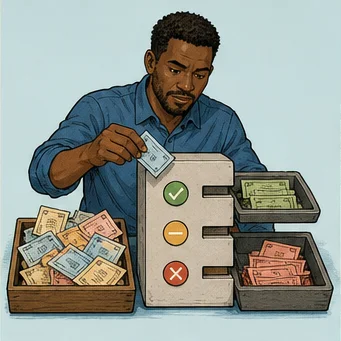

Proprietary trading firm risk management can feel like a maze of arbitrary numbers. You see terms like drawdown and maximum loss, yet the practical application often remains hidden. These rules are not merely guidelines for your performance, they are the functional boundaries that dictate if your account stays open or closes for good. By treating each rule as a calculation rather than a suggestion, you change how you view your trading day.
Before you place your next order, you need a personal dashboard that simplifies these firm-specific mandates. While the firm provides a master list of hard limits, your survival depends on a self-imposed set of tighter, more conservative operating limits. This internal safety net accounts for common issues like market gaps, slippage, and human error. When you shift your focus from hitting profit targets to protecting your remaining headroom, you gain clarity on every trade decision.
This guide helps you deconstruct complex risk rules into simple, actionable steps. You will learn how to monitor equity versus balance, calculate drawdown correctly, manage exposure during volatile events, and build a buffer that keeps your account alive through the inevitable noise of daily market fluctuations. The goal is to move beyond the jargon and establish a reliable routine that lets you focus on your process instead of fearing a sudden account lockout.
Readers building a complete challenge plan can pair this review of understanding prop firm challenge risk rules without the jargon with the prop firm passing service guide, which compares the wider support process and its limits.
Understanding Balance versus Equity
Every trader encounters the distinction between balance and equity, yet many fail to see why it matters for their rules. Your balance represents the total funds in the account after all trades are finalized. Equity, however, is a dynamic figure that includes your current, open profit or loss. Most firms calculate their risk limits against equity, which means a floating loss on an open position affects your account status immediately, even if that position has not yet closed.
Consider a hypothetical example where your account balance is $50,000. You enter a position that quickly moves against you, showing a floating loss of $1,000. Your equity is now $49,000. If your firm enforces a daily drawdown rule of $1,000, that open trade has already brought you to the very edge of your limit. A novice might ignore this because the trade is still open, but the experienced trader recognizes that the equity figure is the only number the firm watches.
Monitor balance and equity
You must monitor both values constantly while your orders are active. Do not assume your closed profit creates a buffer if your open positions are currently underwater. Commissions and overnight swap fees also nibble away at your equity, creating a drag that can lead to an unexpected breach. Always look at your platform dashboard as a living, breathing record of your current status, not a historical report of your past successes.
Create a personal limit that is smaller than the firm's strict maximum. If the firm allows a 5000 total drawdown, set your personal danger zone at 4000. This 1000 buffer is your safety margin. It accounts for wider spreads that occur during news events or minor arithmetic errors when calculating your position size. By acting as if your limit is lower than it really is, you protect your account from the common risks that cause most traders to fail.
Navigating Daily Drawdown Rules
Daily drawdown is perhaps the most misunderstood rule in the industry. It functions as a cap on how much you can lose during a single session, but the definition of a session varies by firm. Some firms reset this limit at the start of the trading day based on your opening balance. Others track your peak equity throughout the day, creating a moving target that resets only at a specific server time. You must know your firm's specific clock.
Imagine a situation where your server resets at 5 PM local time. If you hold a losing position across that rollover, the firm might count the loss from that trade against the previous day, the new day, or both. This ambiguity can cause an accidental breach if you are not careful. Read your contract to see how the firm handles rollover risk, and note the exact time the reset occurs to avoid surprises during a transition.
Calculate daily risk limits
Your daily routine should include a quick calculation of your remaining loss capacity before the market opens. If you have a daily limit of 1000 and you have already lost 400 in the morning, your available risk for the afternoon is only 600. Do not treat these numbers as flexible. When you reach that 600 threshold, your only job is to stop trading for the day. Trying to recover that last 600 often leads to irrational risk-taking.
Reducing exposure is a valid strategy when you approach your daily limit. If you feel uneasy about the market, close your positions or tighten your stop-loss orders well before the rollover. By proactively managing your positions, you remove the element of surprise. Keep a simple log of your daily performance and reconcile it with the firm dashboard at the end of each session to ensure your numbers match theirs.
Managing Maximum and Trailing Thresholds
A static maximum drawdown stays at a fixed level from the moment you start the account. A trailing drawdown, however, moves upward as your account equity or balance hits new peaks. This trailing feature is designed to lock in gains, but it makes the account fragile. If you hit a high point in equity but then give back those profits, your trailing threshold does not go back down with you. It stays at that high level.
Think of a hypothetical account starting at $100,000 with a $5,000 trailing drawdown limit. If your account equity grows to $105,000, your limit might trail up to $100,000. Now, your allowed loss is much smaller. If you have a bad streak and your equity drops to $100,000, you are suddenly at your limit. You have no room for error, even though you started with a much larger cushion. Understand exactly when your firm's threshold stops trailing.
Visualize your drawdown threshold
Many traders sketch their threshold on a physical piece of paper at three key values: the start, the target, and the current equity. When you visualize this line, you can see how much space you really have to maneuver. If you notice the threshold is getting closer to your current equity, it is a sign to reduce your position size. You are no longer trading to hit a grand slam; you are trading to survive the current drawdown period.
Consistency is more important than chasing a single large winner. When you realize the trailing threshold is tight, focus on smaller, higher-probability setups. Avoid the temptation to leverage up to make back lost equity. That is exactly when the trailing limit catches most traders. Keep your risk per trade small, accept smaller gains, and let your account drift back into a safer, more sustainable zone where the limit is not hovering right behind your back.

Leverage is Not Risk
New traders often mistake high leverage for permission to take big risks. In reality, leverage is simply a tool that allows you to control a larger contract size with a smaller amount of money. It says nothing about the actual cash you will lose if your trade goes south. The true risk is determined by your stop-loss distance, the tick value of the instrument, and the total number of lots or contracts you decide to open.
Consider this example. You have a $100,000 account and use 1:100 leverage to buy a position. You think this is fine because you have high leverage. But if you place a stop-loss 50 pips away on a large position size, a single bad trade can cost you $2,000 in cash. The leverage did not make the trade safer. The size of the position and the width of your stop-loss dictated the damage to your account balance.
Size based on risk
Always calculate your cash risk before you enter the market. If you cannot afford to lose the amount required by your stop-loss, you must reduce your volume. Never increase your lot size just because the firm offers high leverage. The leverage is there to help you manage margin requirements, not to encourage reckless position sizing. A disciplined trader always sizes based on their own personal risk threshold rather than the firm's margin limits.
Work from a deliberately smaller personal limit than the maximum allowed by the firm. If you can handle a 500 loss per trade, do not let a wider stop-loss trick you into opening a size that results in a 1000 loss. If the volatility is high and your stop needs to be wider, the only correct adjustment is to decrease your position size. This keeps your monetary risk consistent regardless of market conditions or the leverage available to you.
Exposure and Correlation
Multiple open tickets can mask your true exposure. If you open three separate trades on three different currency pairs that all rely on the strength of the US Dollar, you are not diversified. You are actually taking a concentrated bet on one event. If that event turns against you, all three trades could hit their stops simultaneously, causing a loss that far exceeds your intended risk. This is the hidden trap of correlation.
Group your positions by what drives them. Are you betting on gold, silver, and oil all rising at once? If so, recognize these as one single idea. Cap the combined exposure of these related trades to match your risk limits for a single trade. Including your pending orders in this calculation is essential because they represent future exposure that could trigger at any moment during a volatile move, leaving you vulnerable before you even have a chance to act.
Reduce correlated market exposure
When you look at your platform, do not just count the number of trades. Look at the total impact on your equity. If your current positions are highly correlated, your account will experience larger swings in equity. This can lead to a fast, emotional reaction. By grouping them, you force yourself to see the bigger picture. You may decide that one strong trade is better than three smaller ones that are all tied to the same economic outcome.
Use a simple list to track your active themes. If you have an index trade, a commodity trade, and a currency trade, check if they overlap in their reliance on specific market drivers. If they do, reduce the size of each. This buffer is what protects you from a sudden change in market sentiment. It ensures that no single news release can damage your account beyond your ability to recover.
Related guide for Understanding Prop Firm Challenge Risk Rules Without the Jargon: A useful companion for this decision is How to Check Prop Firm Rules Before You Start a Challenge. Many failed evaluations begin with a rule the trader did not know existed. Save this checklist and review the firm's own terms before you place the first trade.
Creating Personal Buffers
Trading right up to your published drawdown limit is a recipe for disaster. Spread expansion during news, a slight delay in your broker's fill, or even a rounding error in your own calculations can push you over the line. A buffer is a self-imposed boundary that you treat as the true limit. It is the cost of doing business and your insurance policy against the unpredictable nature of live markets.
Choose a buffer amount in your base currency, such as 500 or 1000. Set a mental or digital alert that notifies you when you are approaching this figure. When that alert hits, your job is to stop taking new risks immediately. No exceptions. This is the moment to step back, re-evaluate, and wait for the market to calm down. The temptation to keep trading to push back into the safe zone is high, but that is usually where the biggest mistakes happen.
Maintain personal safety reserves
The buffer also helps with your mental state. If you know you have a safety margin, you can make decisions based on logic instead of fear. You are not fighting for survival; you are executing a plan. When the market moves against you, a buffer prevents you from reacting with panic. You can close a position because the setup is invalid, not because you are terrified of hitting a hard firm limit.
Think of this as a defensive shell around your capital. If your maximum loss is 3000, you essentially operate as if it is 2500. This 500 buffer stays in your pocket as an unused reserve. It is not wasted money; it is your longevity. It gives you the patience to wait for the best setups, knowing that even a bad trade won't ruin your account status. Protect that reserve as if your career depends on it, because it does.
Building a Monitoring Routine
Discrepancies often creep in between your trading platform, your profit calculator, and your own journal. Inputs can get stale, or you might misinterpret the firm's reporting. A daily reconciliation process is mandatory for any serious trader. You should check your records against the firm's official dashboard at the same time each day, preferably after the market close but before the next day's open, to ensure everyone is on the same page.
Your record should be simple. Note your start balance, your current equity, any closed profits or losses from the day, the risk associated with your open positions, and your remaining limit before you hit the firm's thresholds. By writing this down, you turn abstract numbers into a concrete status report. If you see your remaining limit shrinking, you can adjust your position size for the next day accordingly.
Establish strict monitoring routines
Use a spreadsheet or even a dedicated notebook to keep this record. Technology is great, but physical interaction with the data keeps the information fresh in your mind. If your manual calculation does not match the firm's dashboard, do not guess. Stop trading and reach out to support. It is better to miss one session of trading while you clarify your account status than to trade into a potential violation because of a data error.
When you perform this check, remember that the firm's dashboard is the final authority. Even if your internal calculations are perfect, the firm's server time and their specific accounting rules are what matter. Treat these numbers as the ultimate reality of your account. By staying disciplined with this routine, you gain confidence. You know exactly where you stand, and you never have to worry about whether a surprise breach is lurking in the background.

Engaging with Firm Support
Reliable support is one of the most underrated assets in trading. When you reach out to a firm, look for answers that provide specific calculations rather than vague assurances. A quality firm will explain exactly how your drawdown is calculated and exactly what happens if you cross a limit. If the support team gives you a generic percentage or directs you to a social media post, you are not getting the information you need to stay safe.
Ask direct questions. How are the limits monitored in real-time? Is there a human who has the authority to intervene, or is it purely algorithmic? How exactly are rule changes communicated to traders? When you have these answers in writing, you have a reference point that protects you. Save these emails in a folder. If an issue ever arises, having a clear statement from the firm is your best defense against misunderstanding their policies.
Clarify rules with support
Do not rely on the experiences of other traders on social media. Every account can have different rules, and older reviews might be based on policies that no longer exist. Always rely on the written agreement you signed and the current dashboard provided in your account portal. Treat this documentation as your primary manual. If you have any doubt, get it in writing from the firm before you place your next trade.
Remember that you are an independent party working with a firm. Their goal is to maintain their risk protocols, and your goal is to adhere to them while seeking profit. A transparent relationship built on clear communication and defined rules is the foundation of a long-term partnership. When you act with professionalism and seek precise information, you position yourself as a serious trader who understands the rules of the game better than most.
Scaling Positions During High Volatility
High market volatility often triggers sudden price swings that can quickly move your account toward a drawdown limit. Most traders struggle because they keep the same position size regardless of market conditions. When volatility spikes, the distance between your entry and your stop-loss order often needs to be wider to allow the trade room to breathe. Failing to adjust your size means you take on more monetary risk on a single trade than you intended.
Consider a hypothetical example where your usual strategy requires a 50-pip stop-loss. In a calm market, a 1-lot position might risk exactly 500. If the market suddenly becomes twice as volatile, that same 50-pip stop-loss might get hit far more easily. If you widen your stop to 100 pips to avoid the noise, your risk on the same 1-lot position doubles to 1000. You must reduce your position size to 0.5 lots to keep your total risk at the 500 limit.
Scale down during volatility
Your goal is to maintain a constant cash risk per trade rather than a constant lot size. Use a simple calculation before each entry. Divide your allowed risk amount by the dollar value of the distance to your stop-loss. If the market is moving 2 times faster than usual, your stop-loss distance typically needs to be 2 times wider. Adjusting your size downward in these periods protects your equity from rapid drawdowns caused by price whipsaws.
Watch the average true range of your chosen instrument to gauge if you should shrink your size. When this indicator rises, assume your stop-loss needs more room. When it falls, you can potentially increase your size again while maintaining the same cash risk. This dynamic approach keeps your account within its safety zone during both calm and chaotic market conditions.

Related guide for Understanding Prop Firm Challenge Risk Rules Without the Jargon: For the next practical part of your preparation, continue with Position Sizing for Prop Firm Challenges: Protect the Drawdown Buffer. Position size is the bridge between a trading idea and a surviving evaluation. Learn how to size for the stop, the account rules, and the real risk of correlated exposure.
Managing Risk Around Scheduled News Events
Major economic reports or central bank announcements act as binary events that can cause massive price gaps. These gaps are the primary reason many traders fail their evaluation, as price can jump right over your stop-loss order. If your stop-loss is meant to trigger at 100, but the price gaps from 102 to 98, you lose more than expected. This difference can be enough to breach your account limit in one second.
Consider a hypothetical scenario where you have a 1000 daily loss limit. You hold a position before a major inflation report. The market gaps 200 points against you instantly. Your stop-loss is bypassed at the requested price and fills at a much worse rate. Instead of your planned 300 loss, the account takes an 800 hit. This single event brings you dangerously close to your total limit without you ever having the chance to manually intervene.
Minimize news event risk
The most effective strategy involves reducing your net exposure to zero before high-impact news releases. If you do not have an open position, you cannot be hurt by a sudden gap. If you choose to hold through an event, you must accept that your stop-loss is not a guarantee of the exact exit price. Lower your total contract size significantly if you insist on trading through these periods to account for the risk of slippage.
Review an economic calendar every morning to identify these event times. Mark your charts to show exactly when these events occur. If a scheduled report is due within an hour, shift into a maintenance mindset. Close open trades or tighten your stops to a level that you can afford even with significant slippage. Being out of the market during the highest uncertainty is often the smartest move a trader can make.
Implementing Personal Cooldown Periods
Emotional trading is the enemy of account longevity. Most traders experience a cycle where one loss leads to a feeling of needing to win it back immediately. This is called revenge trading, and it is the fastest way to hit a daily drawdown limit. A personal cooldown policy removes the emotional weight by forcing a break after specific triggers. You treat this as a firm rule, even though it is self-imposed.
Set your own triggers for an automatic forced break. A common trigger is two consecutive losses. Another is hitting 50% of your daily loss limit. If your daily limit is 1000, stop trading immediately once you lose 500. Once you trigger this break, walk away from the computer for at least 60 minutes. This creates a hard physical and mental disconnect from the live market feed.
Stop after losing streaks
Imagine a hypothetical day where you lose 300 on your first trade and then 300 on your second. You are down 600 total. If your policy is to stop after two losses, you shut down your platform now. You save your remaining 400 for a day when your mental state is clear. Without this rule, the urge to trade a third time to recover the 600 often leads to a second losing trade that drains your remaining account room.
Document these cooldown events in your log. Use them as data points to improve your strategy. If you find you are hitting your cooldown limit three times a week, your strategy might be too aggressive for the current market environment. The goal is to make the cooldown a rare occurrence rather than a daily habit. Your ability to stop is just as important as your ability to enter a trade.

Handling Technical and Execution Failures
Technical glitches are a part of digital trading. Internet outages, platform freezes, or order execution failures can turn a profitable day into a disaster. You must have an emergency plan that does not rely on your main computer or your primary internet connection. If your platform crashes during an active trade, you need to know how to access your account instantly from a different source.
Keep the customer support number for your broker or firm on your phone. If your platform freezes while you have a large open position, call the desk immediately to close it. Do not wait for the software to restart. Every minute of delay is another minute of potential market movement against you. Having a secondary way to reach the firm is a necessary insurance policy.
Have backup technical plans
Think of a hypothetical case where your internet goes down while you hold a position. You have a 1000 margin of safety left. You quickly switch to your phone data plan and use the mobile version of your trading app. You realize the market is moving against you and close the position manually. Because you had a plan and the secondary app ready, you saved the account from a breach that would have happened if you waited for your router to reset.
Conduct a regular check of your backup equipment. Test your mobile app connection once a week. Ensure you have your account numbers and support contact details saved in a secure, offline location. By preparing for the worst-case scenario, you gain peace of mind. You focus on the trade instead of worrying about the technical infrastructure that supports your account access.
Final Takeaway
The most successful approach is the one that prioritizes account survival over everything else. When you are uncertain about a rule, assume the interpretation that is most restrictive for your account. This conservative mindset ensures that you never accidentally breach a limit due to a misunderstanding of how the firm calculates your losses.
Turn these risk rules into a visible, daily routine. When you translate abstract policies into a simple, daily checklist, risk management becomes a series of routine tasks rather than an intense, stressful calculation. This shift in perspective allows you to trade with a clear head, knowing that your safety net is already in place and that you have fully accounted for the risks you are taking.
Finally, remember that the firm's official dashboard is the only truth that matters. Reconcile your internal records with their data regularly and keep a record of all written communication from their support team. By managing your account as a professional business with clear, documented boundaries, you remove the guesswork and build the stability required to survive the daily ups and downs of the market.