

Advanced risk management goes beyond basic stop placement. It asks how multiple open positions might lose value simultaneously, how market volatility shifts the nature of a standard stop, and where the true survival line of the account sits. Proper oversight ensures that one bad day does not end an evaluation attempt.
The primary objective is not to maximize leverage or push account balances to the limit. It is to preserve decision quality during periods of high stress. When several small risks overlap, they can create a massive cumulative burden. Recognizing this reality allows for more measured, deliberate, and controlled trading throughout the lifespan of a funding challenge.
This article covers one part of the decision. The main prop firm passing service guide explains how advanced prop firm challenge risk management for consistent execution connects with preparation, risk control, and the funded stage.
Risk Units and Account State
A risk unit should reflect the remaining room in your account, not a stale starting balance. Many people forget that the same cash risk becomes a much larger percentage as your drawdown capacity shrinks. If you start with $100,000 in nominal capital and lose $5,000, your effective risk buffer has changed significantly. You must treat the firm's current dashboard, official agreement, and recent written support replies as the only sources of truth. Do not rely on social media posts or outdated reviews that discuss old policy versions. Always record the rule in the exact units provided by the firm, then translate that rule into the specific decision you will make before an order is sent.
Adjust risk for equity
Consider this illustrative example. If your firm allows a 5% total drawdown and you have already drawn down 3%, you are operating with less margin for error. A risk unit that was safe at the start is now too large. Express every proposed loss as a fixed fraction of your remaining personal buffer. If you keep your risk constant while your buffer shrinks, your risk of ruin increases exponentially. You must reduce your unit size proactively after losses occur to protect the remaining equity. This is not about being timid but about acknowledging the reality of a shrinking safety net.
Work from a deliberately smaller personal limit than the published maximum allowed by the firm. If the firm allows a 1% daily loss, set your internal alarm at 0.75%. That extra reserve is what absorbs a wider spread, a delayed fill, or a simple arithmetic mistake. It prevents a manageable error from turning into a critical rule breach. Having this buffer allows you to execute your strategy with a clearer head, knowing that you have built-in defenses against the unpredictable nature of market slippage and operational delays.
Correlation and Common Drivers
It is easy to look at EURUSD, GBPUSD, and a USD index position as three separate trades. In reality, they are often one single macro bet. Correlation between asset classes frequently rises when markets are stressed. If the dollar strengthens, all three positions might move against you at the same time. You must check the underlying drivers of every open position. Treat the firm dashboard and the official agreement as the controlling source for understanding how they define group exposure or correlated risk. Translate those rules into clear, actionable constraints before you place an order.
Build a comprehensive driver map for your portfolio. If you hold positions that all rely on the same fundamental catalyst, such as a central bank rate decision, set a group cap that is lower than your individual trade limit. Reassess this map before major economic data releases. If you notice your portfolio has become too heavy on one side of a trade, reduce the size or exit the weakest positions immediately. Staying diversified is harder than it looks, especially when several different markets appear to offer similar entry setups at the same time.
Manage correlated group risk
Work from a deliberately smaller personal limit than the published maximum for group exposure. That reserve is what absorbs a wider spread, a delayed fill, or an arithmetic mistake. It keeps a group of correlated trades from blowing past your total loss limit during a single period of market volatility. Remember that during high impact news, correlations often jump toward 1.0. This means that if you hold five trades that move in the same direction, they will likely behave like one large position rather than five small ones.
Volatility Regimes
A stop loss that fits perfectly during a quiet, range bound session can be far too small during a volatile one. When market noise increases, your probability of getting stopped out by a temporary whip-saw grows. Keeping your position size unchanged during these periods raises your cash risk or forces you to accept lower trade quality because your stop is too tight. Always check the current market conditions against your initial assumptions. Treat the firm dashboard and official agreement as the final word, and ensure your internal planning reflects the current volatility environment.
Measure the current price range against the recent average range. If the market is moving twice as fast as it was yesterday, you must adjust your approach. Either widen your stop to account for the noise, avoid the setup entirely as planned, or reduce your position size significantly when the stop must expand. If you ignore the changing volatility, you are essentially gambling that the market will remain calm. That is rarely a safe bet in any asset class. Adaptation is the core skill here.
Adapt to volatility regimes
Work from a deliberately smaller personal limit than the published maximum allowed for trades. If the volatility regime shifts suddenly, that extra reserve is what absorbs a wider spread, a delayed fill, or a simple arithmetic mistake. It helps prevent a volatile spike from turning an otherwise ordinary trade into a sudden rule breach. When you see candles getting larger, you must get smaller. This inverse relationship between volatility and position size is a fundamental concept for anyone trying to maintain long term consistency.
Event and Gap Risk
Scheduled news releases, market rollover, weekend closures, and sudden price gaps can easily bypass your normal exit assumptions. During a gap, your stop loss might be skipped entirely, resulting in a loss far larger than you anticipated. Furthermore, some firms have specific restrictions against holding positions over major news events or weekends. It is your responsibility to check the firm rules in the official agreement. Never assume that your platform will automatically protect you from these scenarios. You need a proactive written policy for these moments.
Maintain a precise event calendar that uses the firm server time. Your policy should be binary: either you flatten your position, reduce your size to a negligible amount, or you do not initiate the trade at all until the event passes. Do not try to guess the outcome of a news release. If you are uncertain about the potential for a gap, it is better to be on the sidelines. The risk of holding is simply not worth the potential gain when you are operating under firm constraints.
Protect against event gaps
Work from a deliberately smaller personal limit than the published maximum for holding risk. That reserve is what absorbs a wider spread, a delayed fill, or an arithmetic mistake. If a major headline hits and the market gaps through your exit point, this reserve keeps you solvent. It prevents a catastrophic gap from ending your challenge prematurely. Having a well defined strategy for event risk is the hallmark of a disciplined person who views a prop firm challenge as a structured business rather than a lottery ticket.
Scaling Without Losing Control
A recent winning streak or a rapidly approaching target deadline are very weak reasons to increase your position size. Scaling up when the pressure is on often leads to increased execution errors and larger, more painful, correlated losses. You must avoid the temptation to chase targets by upping the ante. Treat the firm dashboard as the primary source for your current standing. Make your decisions based on the rules, not your emotions or your desire to finish the challenge faster. Scaling requires a formal plan, not just a gut feeling.
Increase your position size only after you have completed a predefined sample of rule compliant trades, and only while a substantial drawdown buffer still remains. If you have been profitable but your buffer is low, you should keep your size steady or even decrease it. You must ensure that each step up in size is mathematically justified. If you cannot explain why you are increasing your size based on your established risk management plan, then you should not do it. Clarity is your best defense against bad decision making.
Scale without losing control
Work from a deliberately smaller personal limit than the published maximum allowed. That reserve is what absorbs a wider spread, a delayed fill, or an arithmetic mistake. If you scale up and the trade fails, that reserve ensures you are still in the game. It prevents an aggressive scaling move from turning into a massive rule breach. You must keep your feet on the ground and remember that one bad series of trades can wipe out a lot of hard work if you lose control of your sizing.

Related guide for Advanced Prop Firm Challenge Risk Management for Consistent Execution: A useful companion for this decision is Position Sizing for Prop Firm Challenges: Protect the Drawdown Buffer. Position size is the bridge between a trading idea and a surviving evaluation. Learn how to size for the stop, the account rules, and the real risk of correlated exposure.
Trailing Drawdown Dynamics
A trailing stop line often moves upward with your gains, which changes the amount of room you have beneath your open positions. Many people make the mistake of thinking that paper profit equals freely spendable risk capacity. This is false. Your risk capacity is governed by the firm rules about your trailing drawdown. Treat the firm dashboard and the official agreement as the controlling source for how your drawdown is calculated. If you fail to update your internal tracking after a new equity high, you might take a trade that violates a hidden rule.
Update your threshold calculation after each material equity high. Before you add any new exposure to your portfolio, model the effect of an open loss. Ask yourself what happens if the market reverses and hits your stop, and then calculate where your balance will be relative to the firm limit. If you cannot accurately model this, you are trading blind. Do not guess. Use a simple spreadsheet or a notes file to track your peak equity and the corresponding floor where your account limit resides.
Monitor trailing drawdown dynamics
Work from a deliberately smaller personal limit than the published maximum. That reserve is what absorbs a wider spread, a delayed fill, or an arithmetic mistake. Even if your account balance suggests you have plenty of room, your real room is determined by the trailing limit. If the market dips, that trailing limit does not move back down with it. It stays at the peak. This asymmetry is exactly why you must keep an extra layer of protection between your current balance and the firm limit at all times.
Build an Exposure Dashboard
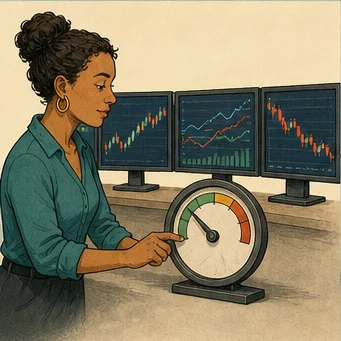
A compact dashboard should show your open cash risk, your daily result, your remaining buffer, your group exposure, your upcoming events, and any pending orders in one clear view. You should not have to hunt for this information. Treat the firm current dashboard and your own agreement as the controlling source. Record every rule in the exact units shown by the firm. Translate that information into the decision you will make before an order is sent. If your information is not centralized, your risk management will be fragmented and likely ineffective.
Update your dashboard before entry and immediately after every fill. If the system you use cannot be updated quickly, you need to reduce the complexity of your trading rather than relying on your memory. Human memory is prone to errors, especially during the heat of a volatile trading session. A simple, manually maintained dashboard can save you from a major mistake. It forces you to pause and think about the implications of every single trade you take, keeping your focus on the numbers rather than the price action.
Track exposure with dashboard
Work from a deliberately smaller personal limit than the published maximum. That reserve is what absorbs a wider spread, a delayed fill, or an arithmetic mistake. Having all your data in one place makes it easier to see when you are approaching that reserve limit. It acts as a safety guardrail. When your dashboard shows you are nearing your personal limit, it is time to stop and reassess. Never proceed until you can explain exactly how your exposure dashboard affects the order you are about to send.
The Standard for Professional Support
Professional support from a firm should explain portfolio exposure in terms of cash and clear scenarios, not hide behind a generic risk percentage. You deserve to know how the firm calculates your limits. Treat the firm dashboard, your signed agreement, and written support replies as the controlling source for this information. Do not rely on speculative advice. Record the rules as they are given to you, then translate those rules into the specific decisions you make every time you prepare to send an order.
Ask for the aggregate loss calculation, your stop authority, and the reporting cadence. Leave if it seems like the firm treats its own limits as obstacles to evade. You want a firm that provides clarity, not one that encourages risky behavior. If a firm is unclear about how they measure risk, they are not a professional partner for your trading. Work from a deliberately smaller personal limit than the published maximum. That reserve is what absorbs a wider spread, a delayed fill, or an arithmetic mistake. It is your only real protection against a sudden shift in firm policy.
Demand professional support standards
Maintaining a standard for your own professionalism starts with how you interact with the service. If you are asking the right questions, you will get the right answers. If the answers remain vague, that is a sign to reconsider your approach or find a better fit. Your goal is to run your account as a business, with strict adherence to rules and a constant focus on preserving your capital. This is not about the thrill of the trade but about the discipline of the process.
Mental Discipline and Decision Loops
Discipline is often viewed as willpower, but it is better described as a decision loop. A well constructed decision loop starts with data, moves to analysis, and ends in a controlled action. If you find yourself rushing into trades, your loop is broken. You are skipping the analysis phase. Treat the firm dashboard as the data input. Your analysis must include checking the current volatility and your own personal risk buffer. If the data does not support the trade, you must have the courage to walk away.
Practice a formal pre-trade ritual. Every time you consider an order, write down the risk, the potential loss, and the reason for the trade. This simple step creates a physical barrier to impulsive behavior. It forces you to translate the abstract risk into a concrete, real number that you have to stare at before clicking buy or sell. If you cannot justify the trade in writing, you should not be in the market. This is how you build a consistent and reliable process.
Enforce mental stop rules
Work from a deliberately smaller personal limit than the published maximum. That reserve is what absorbs a wider spread, a delayed fill, or an arithmetic mistake. Mental discipline also means knowing when to stop for the day. If you have hit your personal loss limit, your loop is done. Do not try to win it back. The market will be open again tomorrow. Protecting your remaining capital is more important than recovering a loss. This is the hallmark of a true professional.

Related guide for Advanced Prop Firm Challenge Risk Management for Consistent Execution: For the next practical part of your preparation, continue with Prop Firm Trading Psychology: Stay Clear Under Evaluation Pressure. Challenge rules turn normal trading variance into a psychological test. These routines help you protect attention, avoid revenge trading, and make the next decision objectively.
Execution Mechanics
Execution is the final step in your risk management chain. Even if your planning is perfect, a sloppy execution can cause a failure. When you enter an order, be mindful of how your platform handles stop loss placement. If your firm requires a stop to be placed at the time of entry, make sure your execution software is set up to handle that automatically. Do not rely on your hands to place a stop after the trade is already open. That introduces human error, which is the enemy of consistency.
Double check the sizing on every single ticket. It is remarkably common for traders to enter the wrong size because they were in a hurry or distracted by a previous trade. A simple decimal point error can be the difference between a small, acceptable loss and a massive, account breaking disaster. Treat each order as a unique, high stakes event. Take an extra three seconds to verify the volume, the stop price, and the profit target before you hit the send button.
Refine execution mechanics consistently
Work from a deliberately smaller personal limit than the published maximum. That reserve is what absorbs a wider spread, a delayed fill, or an arithmetic mistake. If you happen to make a mistake in execution, this reserve provides a margin of safety. It is the difference between a bad day and a closed account. Always approach execution with a methodical, checklist style mindset. Consistency in your mechanics will eventually lead to consistency in your overall results, which is what every serious trader is after.
Long-Term Survival Strategies
Survival is the primary goal in any prop firm challenge. If you are not in the game, you cannot win. Many people treat each day as if it is their last chance, which leads to hyper-aggressive trading that invariably ends in failure. You must shift your mindset from short term profit seeking to long term survival. Focus on how you can remain active for weeks and months, not just how you can pass in a day. Patience is a skill you must practice.
Consider your account as a finite resource, similar to fuel in a vehicle. If you burn it all in the first few miles, you will be stranded. You must pace yourself. This means taking only high probability trades, minimizing your exposure during uncertain market conditions, and always maintaining your internal risk buffer. If you do these things, you will find that you have a much higher chance of making it to your profit target than those who gamble with their capital every single day.
Prioritize long term survival
Work from a deliberately smaller personal limit than the published maximum. That reserve is what absorbs a wider spread, a delayed fill, or an arithmetic mistake. By choosing to trade smaller, you are actually choosing to trade longer. This is the secret to success in this environment. You do not need massive gains to reach your goals. You need consistent, small steps taken over a longer period of time. Build your resilience and let the market do the work for you.
The Analytical Review Process
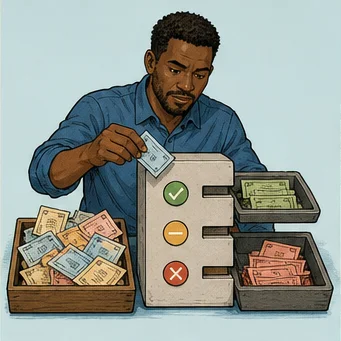
The best way to improve is to conduct an analytical review of your performance at the end of each week. Take all your trades and look at them with a cold, objective eye. Did you stick to your dashboard? Did you respect your personal risk buffer? Did you account for correlated drivers? If you did not, why not? Use this information to refine your process for the following week. This is how you turn experience into genuine improvement.
Be honest with yourself about your failures. If you lost money because of a bad trade, admit it. If you lost money because of an execution error, fix the mechanical process. If you lost money because you were emotional, step away and clear your head. Do not blame the market, the firm, or the economic conditions. These are uncontrollable variables. Your own decision process is the one thing you can actually influence. Keep your review focused on what you can change.
Iterate strategy through review
Work from a deliberately smaller personal limit than the published maximum. That reserve is what absorbs a wider spread, a delayed fill, or an arithmetic mistake. If your review shows you are consistently hitting your personal limit, it is time to reassess your strategy. You may need to trade even smaller or focus on different assets. Remember that the market is always evolving. Your strategies must evolve with it. Continuous, small adjustments are better than large, erratic changes to your entire plan.
Final Takeaway
Sophisticated risk control often results in fewer trades and smaller apparent opportunity. That restraint is a feature when account rules create asymmetric consequences, ensuring you remain in the game while others are forced out by preventable losses.
Use your exposure dashboard to make risk visible before it becomes urgent. A calculation made early is a control; one made after a breach is only an explanation. Prioritize long term survival over the desire for quick, high risk gains by maintaining a consistent, deliberate, and small personal limit.
Always remember that professional risk management is a personal responsibility. The firm provides the rules and the tools, but you are the final filter for every action. By focusing on measurement, correlation, volatility, and event risk, you establish a structure that supports consistent execution over time.